Nothing is missing from the RWA stack
In October, the DTCC moves tokenization out of pilot and into full commercial service. Tokenized recordkeeping becomes a standard option for DTC participants. Not an experiment, not a sandbox, a service feature you can select.
That is the institution that clears the world's securities telling its participants this is now a normal way to do business. In July it was already converting assets held at The Depository Trust Company into tokens used in real production trades. Pilot to operational readiness in a single quarter.
So the thesis is settled. Everybody in my industry has it now, and the conference circuit has been repeating it back all year.
Here is what almost nobody can do: tell you what the stack underneath it actually consists of.
So we drew it
We spent the last stretch mapping the entire lifecycle of a real asset going on-chain, from the loan getting written to an institution posting it as margin. Not a category diagram. The actual sequence of things that have to work.
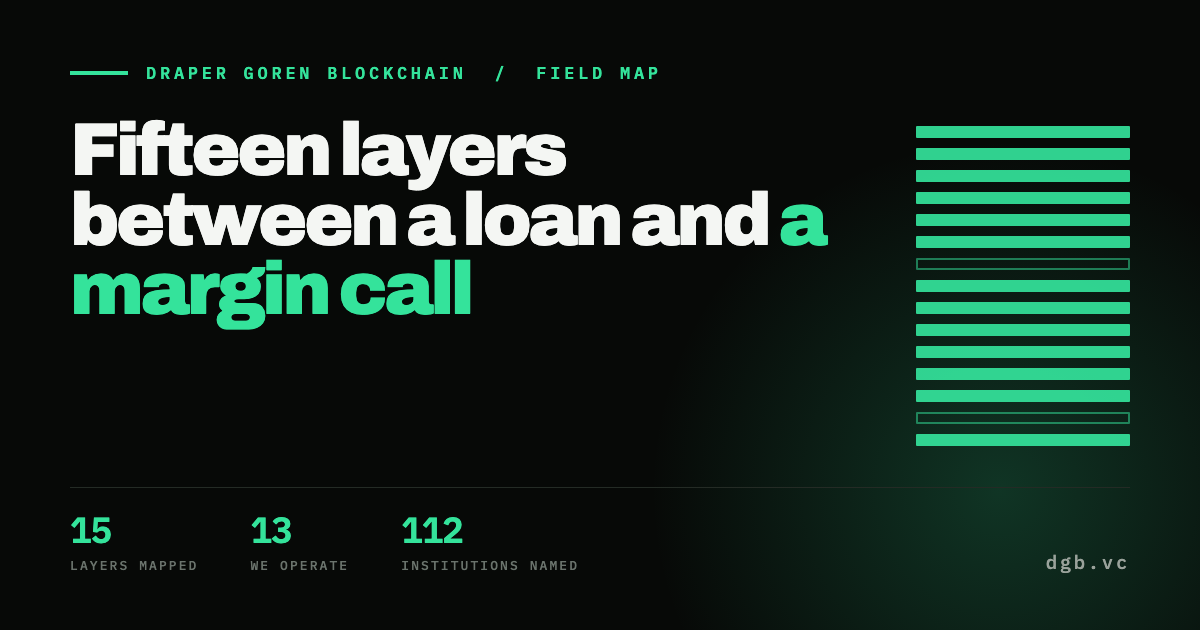
It came out to fifteen layers in five phases.
Create the asset. Origination. Valuation. The physical built world underneath property.
Put it on-chain. Issuance. Transfer agency and recordkeeping. Custody and wallets. Pricing and market signal.
Finance it. Credit rails. Balance sheet.
Move it. Collateral mobility. Distribution. Secondary liquidity. Servicing and bookkeeping. Portable compliance and identity.
Expand what counts as an asset. New asset classes.
Then, against each layer, we put the public milestone proving it is going live. The SEC staff guidance confirming a registered transfer agent can use a distributed ledger as its official Master Securityholder File, which is the moment the chain stops being a copy of the register and becomes the register. The GENIUS Act letting banks custody stablecoins and issue tokenized deposits, with the FDIC's implementing rules proposed in April. Fannie Mae and Freddie Mac standing up UAD 3.6, the first rebuild of the American appraisal data standard in a generation. DTCC taking Chainlink for its Collateral AppChain. Goldman Sachs issuing a blockchain-native real estate fund on GS DAP.
The thing we expected to find, and didn't
I went into this expecting the map to show a hole. Everyone in this category is hunting for the one missing invention, and the usual candidate is an exchange, some venue where tokenized assets will finally trade properly.
We could not find it.
Walk the map layer by layer and every one of them exists in production somewhere in the world today. Some are thinner than others. Continuous valuation for assets that historically traded once a decade is the thinnest thing on the chart. But none of it is waiting on an invention.
It is waiting on adoption, integration and sequencing. Those are questions of time, not of possibility. That is a completely different thing to be waiting for, and it should change how you invest in this.
Liquidity is not a place
The reason people keep hunting for the missing exchange is that they are thinking about liquidity wrong.
Liquidity is not a venue. It is a property of the network.
When any asset can be traded from any financial institution, in any jurisdiction, against any counterparty, on any chain, instantly, without a bilateral integration sitting in the way, the set of reachable buyers stops being a handful and becomes everyone. Options grow exponentially and things start moving. You do not need a new venue for that. You need reachability.
Then add the second half. If the asset can be borrowed against instead of sold, a holder gets liquidity without a buyer existing at all.
ISDA found that 68 percent of variation margin arrives as cash, largely because posting the asset itself was not possible. Tokenized funds accepted directly as collateral turn a forced sale into a transfer. That is liquidity created by connectivity, not by a venue, and it is already working.
The part I still think is underpriced
One force is going to accelerate all of this whether or not anybody gets ideological about blockchains.
The stablecoin economy pulls deposits out of the traditional banking system. There are north of three hundred billion dollars of stablecoins outstanding as I write this. Deposits are what banks lend against, so as that base thins, credit tightens, and it tightens hardest on exactly the borrowers who were already last in line. Small businesses. Community lenders. Regional builders.
Those borrowers do not stop needing money. The fastest route to liquidity against an asset you already own is to tokenize it. So the same force squeezing credit is the force pushing real assets on-chain, for entirely unromantic reasons.
The market is already funding this. Tether and Fasanara launched a four hundred million dollar fund for stablecoin-enabled private credit last week. That is not a crypto trade. That is credit infrastructure getting built because the credit gap is real.
We operate thirteen of the fifteen
Here is the claim, and then the backup.
Most funds are assembling exposure to real-world assets right now. We are not assembling it. We operate thirteen of these fifteen layers through companies we co-founded, incubated or backed early, with partial coverage on the other two, and we say which is which on the map rather than rounding up.
A few of them, to make it concrete.
Origination. Lit Financial is a modern mortgage company and one of the fastest-growing originators in America, with over a billion dollars in originations projected this year, and tokenized treasury infrastructure layered on top of a real lending business. The asset business is real and the tokenization is the accelerant, not the other way around.
Valuation. Aivre is the first appraisal platform in the country verified by both Fannie Mae and Freddie Mac. AI valuation sold to appraisal management companies, cutting more than three hours off every report. Effectively the price oracle for the largest asset class on earth, and a business that has to modernize whether or not one additional asset ever gets tokenized.
The regulated register. AKRU Transfer Agent registered with the SEC effective the fourth of July this year, which makes it a legally recognized backbone for securityholder registries rather than a tokenization vendor sitting next to one. Vertalo has been an SEC-registered transfer agent since 2019 and tokenizing in production since 2018, with more than five hundred million dollars of assets on chain and over two hundred thousand investors on one shared ledger. This layer is invisible, it is regulated, and it is not optional for a single compliant tokenized security in America.
Credit rails. Thurman Labs runs loan-sale infrastructure for community lenders and CDFIs, settling in USDC. It now sells loan servicing to those same lenders, which closed the thinnest layer on the map. That is the credit squeeze above, met head on: the lenders serving the borrowers banks are about to abandon, moved onto modern rails.
Collateral mobility. Ownera, which I co-founded in our first studio era in 2018 and where I sit on the board, runs the FinP2P protocol. An open orchestration layer doing for financial markets roughly what TCP/IP did for the internet, where routers connect to counterparty routers with no bilateral integration in between. Over five billion dollars in monthly trading volume.
What the institutions already did
The standard objection to a map like this is that the technology is ready and the industry is not.
In July, ISDA and Global Digital Finance published their assessment of whether tokenized money market funds work as US institutional collateral. The answer was yes, under all three tokenization models. Over three hundred participants across more than a hundred and twenty firms contributed. Bank of America, BlackRock, Citi, Fidelity, Franklin Templeton, Goldman Sachs, J.P. Morgan, Morgan Stanley, Nomura, State Street, UBS, Vanguard, CME, ICE, Swift.
Forty-eight of those firms ran their sandbox simulations on Ownera. The report's own words are that the live near-production use cases were orchestrated and demonstrated in the GDF Industry Sandbox, powered by Ownera.
Counting across every pilot, working group, network and partnership our companies take part in, the map lists a hundred and twelve institutions and networks by name. The largest asset manager on earth. Two depositories. Two exchanges. Two government-sponsored enterprises. Two federal regulators. Both frontier AI labs.
The question stopped being whether these institutions adopt this. They did. What is left is the order they do it in and how long each integration takes.
Why the studio model wins this one specifically
Real-world-asset companies are infrastructure companies. They win through years in the room with institutions, through regulatory decisions made in month one, through distribution gated by relationships you cannot buy. That is not a game you play from outside with a check.
So we do not wait for these companies to appear and then compete to invest in them. When the company already exists, we want to be the earliest check in it. When it does not exist yet, we build it. We identify the missing layer, recruit the founder, incorporate alongside them, and own at founder economics from the first day.
There is a second-order effect that only shows up once you have a map. Loan servicing is the thinnest thing on ours, and the company now closing that gap is Thurman Labs, which was already in the portfolio one row above for credit rails. The company best placed to close a hole is usually one you already built, sitting next to it.
That is what owning the layer next door is actually worth, and it is why the coverage on this map compounds instead of just accumulating.
What's your take
The map is published and it is a working document. We will keep it current.
Three things I would genuinely like to hear back on.
We drew fifteen layers. Which one would you add, and where would you draw the lines differently?
Which layer is thinner than it looks, and who should we be investing in there?
And if you are building one of them, I would rather hear it from you than read about it later.